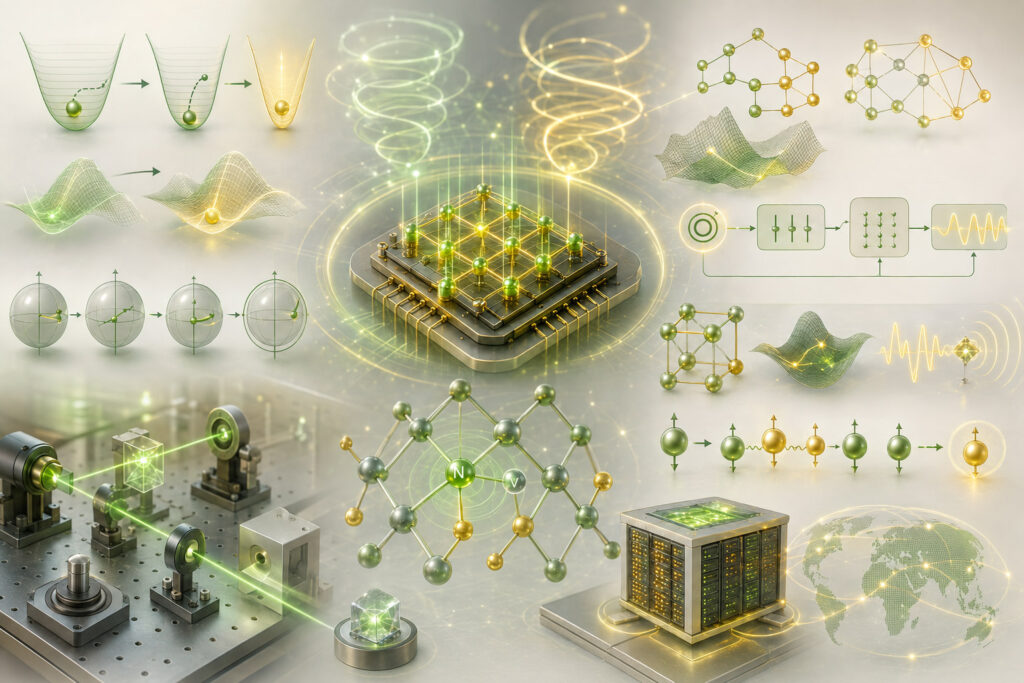
The first concerns the development of shortcut-to-adiabaticity techniques, which enable intrinsically slow quantum processes to be implemented on much shorter timescales, reducing the impact of decoherence and enhancing the robustness of quantum operations and algorithms. A second direction covers the development of advanced numerical tools for the optimal control of complex quantum systems, combining analytical methods, heuristic approaches, and machine-learning techniques. Building on these methods, a third direction applies the resulting strategies to quantum computing, simulation, and sensing, including spin transfer in nitrogen-vacancy centers in diamond and the design of noise-resilient quantum operations. Taken together, these activities link fundamental theoretical advances with practical applications and are carried out in close collaboration with leading international experimental groups.
This research line focuses on the control and engineering of quantum devices and is structured around three complementary directions.